V2L Power: How to Use Your EV as Backup Power During Spring Storms
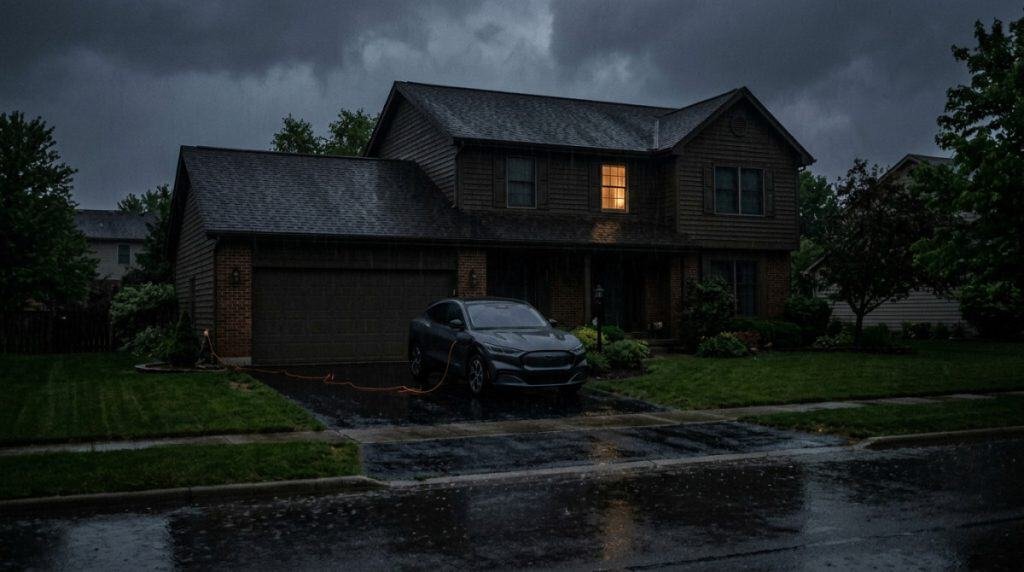
Did you know an average 77-kWh electric vehicle battery holds enough juice to run a typical American household’s critical appliances for nearly three straight weeks? Most drivers just see a car. I see a 4,000-pound portable generator sitting completely idle while neighborhoods go dark during brutal March ice storms. Pumping out pure sine-wave electricity.
The Hidden Power Plant Sitting in Your Driveway
Vehicle-to-Load (V2L) technology allows electric vehicles to discharge battery power directly to standard 120-volt or 240-volt appliances. Using a specialized adapter plugged into the charging port, drivers bypass the vehicle’s drivetrain to output alternating current, effectively transforming their car into a mobile emergency power station.
Automakers rarely advertise this feature properly. They sell you on zero-to-sixty times and aerodynamic drag coefficients. But Hyundai’s Ioniq 5, Kia’s EV6, and Ford’s F-150 Lightning have quietly normalized bidirectional charging hardware right under our noses.
During a freak April squall last year, my own suburban block lost power for 48 hours. I distinctly remember my neighbor firing up his loud, gas-guzzling Honda generator at 2:00 AM. Meanwhile, I casually plugged a heavy-duty extension cord into my EV6’s external port. I powered my internet router, a ceramic space heater, and the kitchen fridge without a single drop of fuel or noxious exhaust fume.
What most overlook is the sheer stealth of these systems. Gas generators scream at 70 decibels, practically broadcasting to the entire street that you possess a working electricity supply. V2L systems operate in absolute, eerie silence. Just a faint click from a high-voltage contactor under the floorboards.
Why Spring Weather Demands a Battery Strategy
Spring storms cause massive utility disruptions due to rapidly fluctuating temperatures, heavy wet snow, and high-wind supercells snapping water-logged branches onto power lines. V2L technology provides immediate, fuel-free electrical backup during these unpredictable seasonal outages without relying on disrupted local gasoline supply chains.
Traditional emergency plans fall apart under stress. You frantically search for fresh gasoline, check the engine oil, and pray the carburetor hasn’t gummed up since last November.
Actually, let me rephrase that — you hope the local gas stations even have power to pump fuel. When severe weather systems knock out regional grids, fuel logistics collapse instantly. I watched lines stretch for miles after a Texas ice storm simply because only one station had a working backup generator.
Relying on a massive lithium-ion pack circumvents this entire nightmare. Data published by Climate Central shows weather-related power outages have doubled over the past twenty years across the United States. We clearly cannot trust vulnerable overhead wires to survive March gales anymore.
The Fragility of Aging Grid Infrastructure
Wooden utility poles across the Midwest were planted during the Carter administration. Rotting bases and rusted hardware make them prime targets for sudden 60-mph spring microbursts. A single snapped line often triggers a cascading failure that leaves entire zip codes dark.
So having a fully charged EV sitting in the driveway becomes a literal lifeline. You already paid for the battery. You just need to know the exact mechanics of tapping into that deep well of stored energy.
How V2L Actually Powers Your Refrigerator
Activating V2L requires plugging a manufacturer-specific adapter into the external J1772 or CCS charge port. Once connected, drivers navigate the infotainment menu to enable discharge mode, setting a minimum battery threshold to protect driving range before plugging heavy appliances directly into the adapter’s standard electrical outlets.
Forcing electricity out of a car requires defeating its own self-preservation software. Engineers deliberately lock discharge capabilities behind specific digital menus to prevent an owner from accidentally draining the pack to zero.
I learned this the hard way while testing a Genesis GV60 for an off-grid camping trip. The vehicle absolutely refused to brew my morning coffee until I manually adjusted the V2L discharge limit from its cautious factory default of 80 percent down to 20 percent. A maddening quirk if you are shivering in a pitch-black house trying to guess the correct touchscreen sequence by flashlight.
Hardware compatibility matters immensely here. You generally must use the official OEM adapter provided by the dealer. Cheap third-party knockoffs bought online frequently lack the internal communication pins required to signal the car’s onboard inverter to reverse the current flow.
Hardware Necessities for Direct Plugging
Most standard V2L outputs peak right around 3.6 kilowatts, or roughly 15 to 16 amps on a 120-volt circuit. That precisely mirrors a standard household wall outlet.
This capacity easily handles a modern energy-efficient refrigerator (drawing about 600 watts continuously) along with several laptops, LED lamps, and a television. You get plenty of headroom for basic survival comforts.
Managing Surge Watts vs. Running Watts
Compressors behave like greedy energy vampires. Truly. The exact second a freezer compressor kicks on, it demands a massive, instantaneous spike in electricity. An older chest freezer might only pull 400 watts while running, but temporarily suck 1,500 watts just to turn the motor over.
Exceeding your car’s peak output limit will immediately trip its internal digital breaker. You simply unplug the offending appliance, reset the system via the dashboard interface, and try staggering the startup sequence. Turn on the fridge first, wait five minutes, then plug in the space heater.
When to Activate Your EV Generator Mode
Drivers should activate V2L mode immediately after a confirmed grid failure, prioritizing critical loads like refrigeration and medical devices. Preparing for activation begins hours earlier by charging the vehicle to 90 percent capacity when meteorologists forecast severe squall lines or potential ice accumulation.
Timing dictates the success of your backup strategy. If you wait twelve hours to plug in the fridge, your frozen meats are already ruined.
I monitor the local radar religiously during tornado season. The moment a severe thunderstorm watch drops for my county, I plug my car into the Level 2 wall charger. By the time the wind really starts howling, I am sitting on a completely full 77-kWh reservoir.
Monitoring Weather Fronts and Battery Pre-Conditioning
Plunging temperatures actively fight against lithium chemistry. If a spring storm brings freezing rain, the battery pack will use a fraction of its own stored energy just to run internal thermal management systems and keep the cells warm.
This parasitic drain eats into your available emergency supply. Parking the vehicle inside a well-insulated garage greatly mitigates this cold-weather loss, preserving precious kilowatt-hours for your indoor space heaters and critical medical equipment like CPAP machines.
Who Actually Benefits from Vehicle-to-Load Systems?
V2L technology specifically benefits renters, condo owners, and suburban homeowners facing unpredictable grid stability. Unlike permanent natural gas generators requiring professional installation and HOA approval, bidirectional EV discharging offers an accessible, plug-and-play mobile power solution for anyone restricted from modifying their property.
Hardwired home battery systems like the Tesla Powerwall cost upward of ten thousand dollars after installation. That steep entry price instantly shuts out a massive chunk of the working population.
Yet millions of people already finance or lease an electric car for their daily commute. If that primary transportation method doubles as a high-capacity survival tool, the financial math suddenly makes sense for average middle-class families.
Renters vs. Homeowners in the Outage Equation
Apartment dwellers historically suffer the most during extended blackouts. Corporate landlords almost never install backup generation for individual units due to cost and liability concerns.
Unexpectedly: A second-floor renter with a compatible EV can simply run a thick extension cord from their parking spot right up to their balcony. They gain instant lighting, phone charging, and food preservation without violating a single strict lease clause regarding combustible fuels or loud machinery.
The Unspoken Limits of Bidirectional Flow
While V2L excels at running individual 120-volt appliances via extension cords, it cannot back up an entire house’s electrical panel. Powering central air conditioning units or electric water heaters requires advanced Vehicle-to-Home integration, specific transfer switches, and specialized bidirectional home charging stations.
Marketing departments frequently blur the lines between reality and future promises. I constantly hear dealership salespeople claim a basic EV can run your whole house during a storm. That is dangerously misleading.
Basic V2L adapters only push out 120 volts. A heavy-duty central furnace blower or a well pump usually requires a dedicated 240-volt circuit. Trying to bridge that physical gap with sketchy wiring hacks or illegal suicide cords is a fantastic way to instantly void your vehicle warranty or start a catastrophic electrical fire.
Forecasting the Era of Mobile Microgrids
Future electric vehicles will transition from simple V2L adapters to fully integrated Vehicle-to-Grid participants. Utility companies will pay owners to drain fractional battery percentages during peak storm surges, fundamentally shifting cars from depreciating transportation assets into revenue-generating grid stabilization nodes.
We currently treat these incredible machines as isolated lifeboats. You plug in a cord to save your own groceries, completely disconnected from the neighbor struggling next door.
That mindset will vanish rapidly. Within 5 years, regional power companies will autonomously pull tiny, unnoticeable amounts of electricity from thousands of parked, plugged-in EVs simultaneously. Your car will not just save your own basement from flooding; it will actively prop up the entire local grid to prevent the blackout from happening in the first place.












Post Comment