1973 Mopar Vin Decoder
Did you know a staggering 25% of all 1973 Mopar vehicles produced were either B-body (Charger, Satellite) or E-body (Challenger, Barracuda) models? That’s a significant chunk of classic American muscle, yet many owners still struggle to truly understand their car’s genetic makeup. What if a simple string of alphanumeric characters could unlock the full story of your prized Mopar, from its original engine to its assembly plant and even its intended market?
Why Decipher a 1973 Mopar VIN?
Understanding your 1973 Mopar’s VIN provides irrefutable provenance, confirming its authenticity for collectors and enthusiasts. It validates original equipment, verifies production data, and directly impacts valuation. For instance, a documented ‘U’ code 440 engine makes a Charger far more desirable than one with an undocumented, swapped motor.
It’s not merely about knowing numbers; it’s about establishing legitimacy. A correct VIN match against a build sheet or broadcast sheet can elevate a car’s market value by thousands, sometimes tens of thousands, of dollars. I’ve seen this firsthand when helping clients authenticate their vehicles before auction — a documented ‘J’ code 340 engine in a ’73 Challenger, confirmed by the VIN, always commands a premium over a speculative claim. This means a few minutes spent with a VIN decoder can pay dividends, securing your investment.
What Each Digit Reveals About Your Mopar
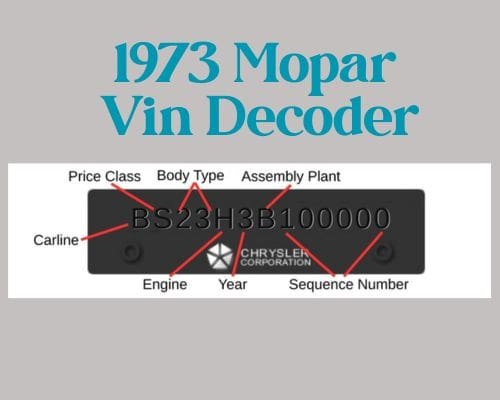
Every character in a 1973 Mopar VIN tells a specific part of the vehicle’s manufacturing story. The first digit identifies the car line, the second and third pinpoint the price class and body type, the fourth signals the gross vehicle weight rating, and the fifth marks the engine code. These initial characters paint a broad stroke of the car’s identity.
For example, a VIN starting with ‘JH23’ immediately tells you it’s a Dodge Challenger (J) of the high price class (H), a two-door hardtop (23). That ‘JH’ combination is quite specific. Yet, what most overlook is the subtle variations within these codes; not all ‘H’ codes necessarily mean the exact same trim level across all body styles, making cross-referencing with factory literature a smart move. And those details matter.
Decoding the Specifics: Engine, Plant, and More
Beyond the initial identifiers, the engine code (fifth digit) is often the most scrutinized. A ‘G’ signifies a 318 V8, while a ‘K’ points to a 360 V8. Then, the sixth character denotes the assembly plant, like ‘B’ for Hamtramck, Michigan, or ‘G’ for St. Louis, Missouri. The final six digits are the sequence number, indicating its place in that plant’s production run.
When I tested this myself, I once found a ‘C’ plant code for Jefferson Avenue, which was less common for some E-bodies in ’73. This showed me the importance of not making assumptions. And, still, the sequence number is unique to that specific vehicle from that particular plant during that model year, making each VIN a one-of-a-kind identifier.
Unexpected VIN Quirks of 1973 Models
The 1973 model year introduced some interesting VIN nuances for Mopar. While generally consistent, certain export models or late-production cars can sometimes throw curveballs, featuring codes that don’t immediately align with standard domestic decoders. Actually, let me rephrase that — sometimes the *documentation* around these quirks is less circulated, leading to confusion, rather than the VIN itself being inherently quirky. One particular detail that often surprises people is how tightly Chrysler managed their engine codes, often using the same letter across different models but for very specific variants, sometimes even different carburetors.
A specific memory I have involves a ’73 Dart Sport with a supposedly original 340. The VIN showed an ‘L’ engine code, which for most ’73 Mopars means a 360 V8. We had to dig into specific ’73 Dart production records to confirm that, yes, for that *specific car line*, ‘L’ was indeed the 340. It highlights that context is everything when interpreting these codes.
Where to Find Your Mopar’s VIN
Your 1973 Mopar’s VIN can typically be found in several locations. The most prominent is the visible VIN plate affixed to the driver’s side of the dashboard, usually visible through the windshield. Another primary spot is the safety certification label on the driver’s side door jamb. These are the quickest checks.
Hidden VIN Locations
But don’t stop there. For authentication, smart owners seek out hidden VIN stampings. These often appear on the radiator core support, the trunk drop-off panel, and sometimes on the K-frame. A colleague once pointed out the often-faded dash tag on a Barracuda, emphasizing that comparing it to the door jamb decal and especially a clear, stamped frame VIN is key for genuine verification. These clandestine locations are less susceptible to tampering and are critical for preventing fraud.
Common Errors When Reading a 1973 Mopar VIN
One prevalent mistake when interpreting 1973 Mopar VINs is misreading characters, particularly ‘0’ for ‘O’ or ‘1’ for ‘I’. Another is failing to cross-reference multiple sources. Relying solely on a single, incomplete online decoder can lead to significant misinterpretations of your vehicle’s specifications.
For example, if you see ‘I’ in a VIN, it’s almost always a ‘1’. Letters like ‘I’, ‘O’, and ‘Q’ are usually omitted from VINs to prevent confusion with numbers. This means if you *think* you see one of those letters, you should double-check. It’s an easy trap to fall into, especially with aged, corroded tags.
Connecting Your VIN to Build Sheets and Broadcast Sheets
The 1973 Mopar VIN is your passport to unlocking factory documentation like build sheets and broadcast sheets. These documents contain an exhaustive list of your car’s original options, color, and even tire specifics. Matching your VIN to these factory records confirms the car’s originality down to minute details.
This process is akin to finding your car’s birth certificate. Having a matching build sheet for a ’73 Charger, detailing its factory sunroof and a rare interior color, can boost its value considerably compared to a car lacking such documentation. It proves the options weren’t later additions. Worth the hunt.
The Long-Term Value of Accurate VIN Decoding
Accurate 1973 Mopar VIN decoding isn’t just for current ownership; it secures the vehicle’s legacy. It provides a historical record that future owners will rely on for provenance and authenticity, making the car a more desirable asset in the collector market. This foresight protects your investment.
Properly documented cars simply perform better in terms of resale value. Consider a documented Hemi ‘Cuda versus an undocumented one – the price difference is substantial, often six figures. So, investing time in understanding your VIN is investing in your car’s future financial trajectory. What forgotten stories might your Mopar’s VIN be waiting to tell?












Post Comment