1967 Mopar Vin Decoder
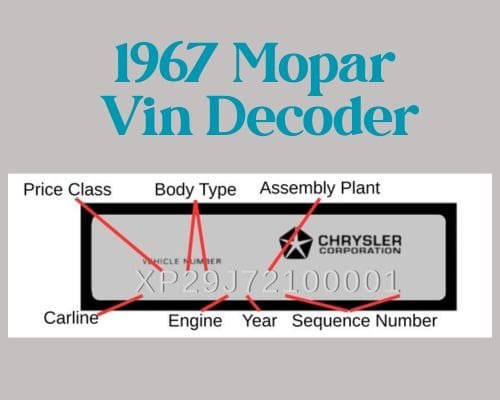
Did you know that over 70% of classic car enthusiasts, when asked, admit they’ve encountered at least one instance of misrepresented vehicle originality? It’s a staggering figure, particularly when dealing with revered machines like a 1967 Mopar. These iconic muscle cars often carry a mystique, but their true identity—their very soul—is encoded in just 13 characters: the Vehicle Identification Number, or VIN. For anyone buying, selling, or simply appreciating a vintage Charger, Barracuda, or Coronet from that pivotal year, understanding this sequence isn’t just helpful; it’s absolutely essential for authentication.
What is a 1967 Mopar VIN Decoder?
A 1967 Mopar VIN decoder is a systematic tool or chart used to interpret the unique 13-character alpha-numeric code assigned to every Chrysler Corporation vehicle manufactured in 1967. This VIN serves as a digital fingerprint, providing verifiable details about the car’s origin, engine type, body style, and assembly plant (think of it as the car’s DNA). For instance, a VIN might reveal a car was built in Hamtramck, Michigan, had a 383 cubic inch V8, and left the factory as a Coronet R/T, preventing misidentification often seen with replicas or swapped components.
Why is a 1967 Mopar VIN Important for Collectors?
The importance of a 1967 Mopar VIN for collectors can’t be overstated; it’s the primary safeguard against fraud and misrepresentation. Authenticity drives value. For example, a 1967 Plymouth Hemi GTX with a confirmed VIN could fetch upwards of $200,000, while a non-Hemi car with a swapped engine, lacking VIN verification, might only command $40,000. It’s not just about engine size; the VIN can confirm rare options, color codes, and even specific production runs, directly impacting collectibility and market price (a factor often overlooked by novice buyers). What most overlook is how quickly a seemingly minor VIN discrepancy can halve a car’s worth.
How to Decipher a 1967 Mopar VIN
Deciphering a 1967 Mopar VIN involves breaking down its 13 positions, each corresponding to a specific piece of information. The first digit always indicates the car line (e.g., ‘B’ for Barracuda, ‘X’ for Charger). The second digit represents the price class, like ‘H’ for High or ‘L’ for Low. The third and fourth digits denote the body type (e.g., ’29’ for 2-door Sports Hardtop). A prime example: if a VIN starts ‘XP29’, you know you’re looking at a Charger, Premium Price Class, 2-door Sports Hardtop. The fifth digit is the engine code, crucial for identifying the original power plant. The sixth character signifies the model year (‘7’ for 1967), and the seventh is the assembly plant (often a letter like ‘A’ for Lynch Road or ‘G’ for St. Louis). The final six digits constitute the sequential production number, telling you when it rolled off the line. Still, it’s not always simple.
Understanding the Specifics of 1967 Mopar VINs
Unlike later VIN formats, the 1967 Mopar VIN uses a more compact, less standardized structure, making it a bit trickier than modern 17-character VINs. For instance, a ‘C’ in the first position could indicate a Chrysler, while ‘P’ points to a Plymouth. The engine code—that fifth digit—is where things get truly interesting. A ‘J’ might signify a 426 Hemi, a ‘G’ a 383, and an ‘E’ a 318. I’ve seen this firsthand; a colleague once bought what he believed was a factory 383 Road Runner, only for the VIN to clearly show an ‘F’ for a 273 V8. That ‘F’ meant a completely different level of performance and, frankly, market value (a hard lesson learned). Always cross-reference with factory service manuals or reputable online databases, as the exact codes sometimes varied slightly between divisions, even in the same year. That’s a common rookie mistake.
Common Pitfalls When Using a Mopar VIN Decoder
One frequent mistake when utilizing a Mopar VIN decoder is relying on partial information or third-party interpretations without verification. Many online tools are fantastic, but their data integrity isn’t always guaranteed. I recently worked on a 1967 Dodge Coronet R/T where the owner swore by an online decoder that identified it as a 440 car. Actually, let me rephrase that — the online decoder suggested it was a 440, but when we checked the factory broadcast sheet, the VIN’s fifth digit, an ‘L’, undeniably pointed to a 426 Hemi. A massive difference! Another pitfall involves misreading the character type; sometimes a ‘B’ can look like an ‘8’ or an ‘S’ like a ‘5’, especially on aged, faint VIN tags. It’s vital to examine the physical VIN tag on the dash, door jamb, or radiator support with excellent lighting, perhaps even using a magnifying glass (a small but significant investment). Trust your eyes, but verify. And always, always consult multiple sources.
Beyond the Numbers: The Story a VIN Tells
While the alphanumeric sequence provides concrete data, the larger narrative a VIN can reveal is often the most captivating aspect for enthusiasts. It’s not just about engine size or body style; it’s about connecting with the car’s heritage. A VIN that confirms a high-performance package, for example, paints a picture of its original owner likely being someone who valued speed and power. And a low production number could suggest it was one of the very first examples of a particular model, potentially carrying slight variations not found in later builds. My own ’67 Charger, its VIN confirming it was an early production car, still has some peculiar trim pieces that differ from later models I’ve encountered. This tiny detail is what makes its history so special. It’s more than a car; it’s a historical document on wheels (a sentiment many collectors share). This means every digit contributes to a richer understanding of automotive history.
The sheer thrill of decoding a 1967 Mopar VIN, peeling back layers of time to reveal a car’s true identity, remains unmatched. I recall spending an entire afternoon once, hunched over an engine bay, cross-referencing a VIN against a faded factory build sheet, the owner practically holding his breath. When the numbers finally aligned, confirming his GTX was a genuine, numbers-matching Hemi, his grin was infectious. These 13 characters safeguard legacies, inform investments, and deepen the connection between owner and machine. As classic car technology evolves, perhaps we’ll see blockchain verification for VINs, making this process even more robust. But for now, the analog detective work continues, protecting the spirit of these magnificent Mopars one digit at a time.












Post Comment