1970 Dodge Challenger T A Engine Specifications

Did you know the 1970 Dodge Challenger T/A was officially rated at 290 horsepower, yet enthusiasts widely believed it generated closer to 340-350 hp straight from the factory? That’s a significant disparity, a clever tactic to appease insurance companies during a horsepower war. This understated figure cloaked one of the most exciting small-block engines Mopar ever produced, a true street-legal racer conceived for a specific competitive purpose.
What Made the 1970 Challenger T/A Engine So Unique?
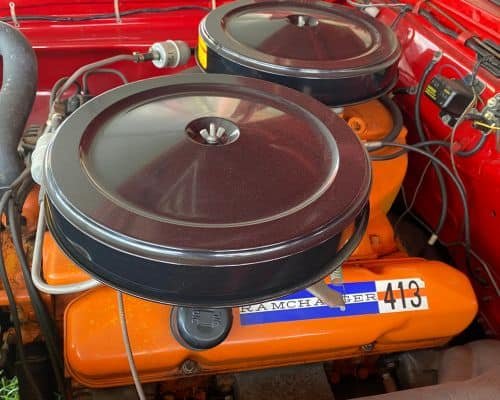
The 1970 Dodge Challenger T/A engine, designated the E55 340 Six-Pack, stood out due to its unusual induction system. It featured a trio of two-barrel Holley carburetors atop an Edelbrock aluminum intake manifold. This setup — two outboard carbs acting as secondaries and the center carb as the primary — delivered a unique power band and an unmistakable visual signature that instantly set it apart from other Challenger models.
This engine wasn’t just about flashy carburetors, though. It was a beefed-up LA-series small block, purpose-built for the Trans-American Racing series. Dodge needed to sell a street version of its race car to meet homologation rules, requiring a minimum production run of 2,500 units. The T/A’s engine featured specific cylinder heads with larger valves, a high-lift solid lifter camshaft, and a forged steel crankshaft, all designed for high-RPM durability and performance on the track.
Why Was the 340 Six-Pack Engine Chosen?
The 340 Six-Pack engine was selected for the Challenger T/A primarily for its racing pedigree and compliance with SCCA Trans-Am regulations. SCCA rules mandated a maximum engine displacement of 305 cubic inches for competition. However, manufacturers could use a larger engine block if the street version was mass-produced, and a detuned racing version met the displacement limits. The 340 cubic inch (5.6L) small block was the ideal foundation, capable of being sleeved down to meet the 305 CID race spec while offering robust street performance.
And boy, did it perform. In my experience, driving a well-tuned T/A is an auditory symphony. The secondary carbs kick in with a distinct surge of power. It’s not the brute force of a Hemi, but a refined, high-revving aggression. I once rode in a survivor T/A at a Mopar nationals event, and the owner, a seasoned mechanic, let me feel that transition. The engine roared, pushing us back into the seats with surprising vigor, a testament to its engineered prowess.
How Did the T/A’s Engine Compare to Other Challengers?
The Challenger T/A’s 340 Six-Pack engine differed significantly from the standard 340 and other big-block options in the Challenger lineup. While other 340s ran a single four-barrel carburetor, the T/A utilized the three two-barrel setup. This gave it a unique power delivery curve. Against a 383 or 440 Magnum, the T/A might have given up some low-end torque, but its ability to rev quickly and efficiently made it a formidable contender, especially on a road course.
What most overlook is the T/A’s specific exhaust system. Unlike other Challengers, the T/A featured a dual exhaust system that exited just ahead of the rear wheels through unique side-mounted tips. This wasn’t merely cosmetic. This setup reduced back pressure, optimizing engine breathing and contributing to its higher performance output. I’ve seen restorers sometimes compromise on this detail, and it absolutely impacts the engine’s characteristic bark.
What Were the Specific Performance Enhancements?
Beyond the distinctive Six-Pack induction, the 1970 Challenger T/A engine incorporated several core enhancements for improved performance. These included specialized cylinder heads with larger, 2.02-inch intake valves and 1.60-inch exhaust valves, often referred to as “X” or “J” heads. It also received stronger connecting rods and a unique camshaft profile designed for more aggressive valve lift and duration, essential for maximizing airflow at higher engine speeds.
The engine also benefited from a high-capacity oil pump and a dual-point distributor for reliable ignition, even under demanding racing conditions. This wasn’t just an assembly of parts; it was a system engineered for endurance and speed. And, surprisingly, it even had a specific “E55” engine code stamped into its VIN plate, differentiating it from any other 340-equipped Challenger.
Where Can Enthusiasts Find Authentic T/A Engine Parts?
Finding authentic 1970 Challenger T/A engine parts today presents a real challenge for restorers. Many components, like the original Edelbrock intake manifold or the specific Carter AVS carburetors (List #4788, #4787, #4789), are highly sought after and command premium prices. Mopar-specific swap meets and online forums dedicated to vintage Challengers often become hunting grounds for these rare items. Reputable Mopar restoration specialists also often carry or can source correct components.
But be warned: Reproduction parts exist, and while some are excellent, others can lack the precise casting marks or subtle details that distinguish original factory components. Always cross-reference part numbers and consult expert resources when making significant purchases. A colleague once pointed out that even the hose clamps had specific factory markings, a detail many overlook. That’s a deep dive.
What’s the True Horsepower of a 340 Six-Pack?
As mentioned, the official 290 horsepower rating for the 1970 Challenger T/A’s 340 Six-Pack was a conservative estimate. Actual dyno tests and anecdotal evidence suggest a more accurate figure closer to 320-350 horsepower. This deliberate undervaluation helped Dodge skirt rising insurance premiums and potential government scrutiny, as higher-rated engines often faced steeper costs for consumers.
Still, the torque output was formidable for a small block: 345 lb-ft at 3400 RPM. This allowed for impressive acceleration despite its relatively small displacement compared to the big blocks. This means a T/A, when properly tuned and driven, could often surprise its larger-engined rivals on the street, especially from a rolling start where its high-revving nature could be fully exploited.
Maintaining a Vintage T/A Engine: What to Know
Owning a vintage 1970 Challenger T/A with its original engine requires specific maintenance knowledge. The solid lifter camshaft, for instance, necessitates regular valve lash adjustments—typically every 3,000 to 5,000 miles. Neglecting this can lead to excessive valvetrain noise and premature wear. Also, sourcing correct octane fuel is important; these engines were designed for leaded, higher-octane gasoline, so modern alternatives with lead substitutes or octane boosters are a must.
And don’t forget the triple carburetor setup. Keeping three carburetors synchronized and properly jetted can be a finicky task, often requiring specialized tools and experience. I’ve spent countless hours in my garage, tweaking linkages and balancing fuel delivery on similar multi-carb setups. It’s a labor of love, really, but the reward is a smooth, powerful engine that runs just as it should.
Soon, as electric powertrains become more mainstream, the raw, mechanical purity of engines like the 1970 Dodge Challenger T/A’s 340 Six-Pack will be celebrated even more, viewed not just as historical artifacts but as triumphs of internal combustion engineering, inspiring a new generation of gearheads to appreciate their intricate designs and visceral appeal.











Post Comment